The Château du Barroux and the St. Christophe Chapel
A visit and a short hike for the view
walk
easy
2 h
yes
no
shelter
walk
Introduction
Le Barroux is a small village nestled between the majestic Mont Ventoux and the Dentelles de Montmirail. Its castle is beautifully restored and well worth a visit. Afterward, we can descend the hill and climb another, crowned by a chapel, offering a beautiful view back to Le Barroux and its castle at the summit.
This large fortress dates back to the 12th century. It was originally owned by the Baux family. Remodeling took place until the 18th century, and since then the structure has undergone few changes. Today, the castle is privately owned and undergoing some renovations. However, visits are possible.
The facts
2,4 km total distance
2 h walk time
120 m total elevation
orientation easy
mark 80% of the total distance
60% hard-surfaced city alleys
20% forest roads
10% easy trails
10% indoor
dangers none
children yes
useful picnic stuff
required trekking boots, hiking equipment and water
GPS coordinates (WGS84) of start and end point 44.1390322119429,5.101623122321033
downloads 

Public transport
There is a regional train line between Avignon and Carpentras, see the information under TER PACA (only french).
From Carpentras, buses depart for Malaucène, with approximately six buses per day in each direction. Look for line K underTrans'CoVe (only french).
Get off the bus at the Louise Raymond stop, walk up the upper lane, and enter the village. Just before the first houses, there is a path on the right leading up to the castle parking lot. This is the starting point.
Access by car
Le Barroux is located between Vaison-la-Romaine to the north and Carpentras and Avignon to the south. Coming from the north, you pass Malaucène without heading towards Mont Ventoux. The next town is Le Barroux. Enter the village from the north. Follow the signs to Château du Barroux, the parking lot is then soon on the left.
Useful parking spaces
Stay in the newly developed lower parking lot and do not drive any higher, as you will return to the starting point at this lower parking lot.
No reproduction is permitted without the written consent of the author. (id8438)
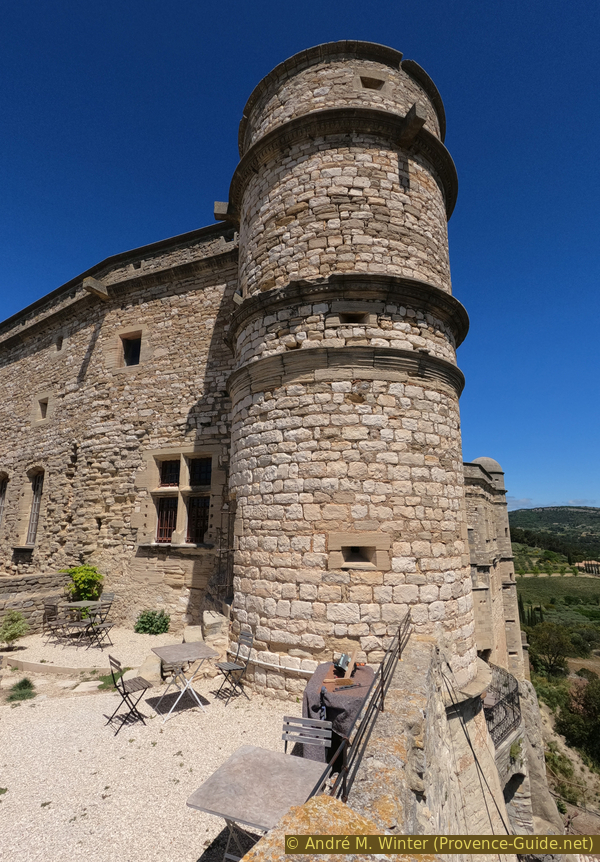
Southeast corner tower of the Château du Barroux
Hints
The self-guided tour costs EUR8.50 per person (2026). Access is available daily from 10:00 to 18:00, with a break from 13:00 to 14:00 during the off-season. Closed in January.
Cheese and whisky tasting evenings are also offered. The whisky has been produced since 2025. Basic ingredients such as einkorn wheat and barley are grown by the owners. The shop is also located at the reception area.
This tour is very short, but during the warmer months, it can get very hot here, so you'll still work up a sweat.
The whole region is a zone with a high risk of forest fires. In summer, but also in other seasons when it is very dry or by strong winds, access to the forest areas can be regulated. As a result, the roads may be closed to traffic and/or the trails prohibited to hikers. Current information: Map for access to the forests of the Vaucluse department (also english). The map shows the colours green, yellow, orange and red which correspond to levels of danger. The affected area is: Massif des Dentelles de Montmirail (12).
The sections
- Visit to the Château du Barroux
- To the Chapel of St. Christopher
- Pass through the village of Le Barroux
Section 1: Château du Barroux
➙ 0,7 km ... 1 h ➚ 25 m ➘ 10 m ↝ easy
30% easy trails, without marks
35% indoor, few marks
35% hard-surfaced city alleys, without marks
The clues
- Car Park Château du Barroux, 320 m
- Château du Barroux, 345 m
- Chemin du Barry, 330 m
We go straight up to the castle for the visit.
On the lower parking lot of Château du Barroux, there are restrooms. Just behind them, a small path begins, passing above the houses and then turning to the right.
From here, the castle comes into clear view, this side is otherwise not so easy to see.
We then turn right again to reach the road that leads up to the castle.
No reproduction is permitted without the written consent of the author. (id8391)
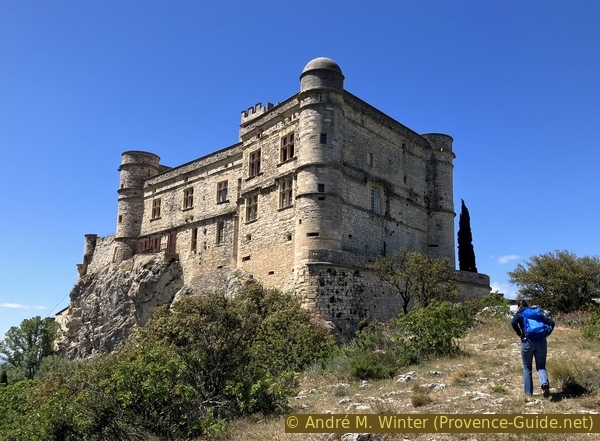
The Château du Barroux seen from the northeast
We pass through the first gate in the castle's defenses and arrive at the entrance to the inner courtyard.
Works by Sandrine Guilbot, also Sandrot, are displayed in various locations. Next to the entrance is the T18 tiger in cool colors.
The ticket booth is located inside.
No reproduction is permitted without the written consent of the author. (id8392)
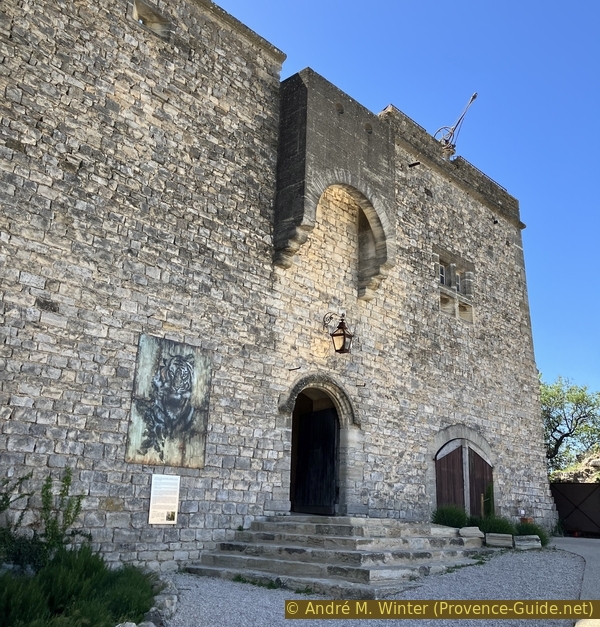
Entrance to the Château du Barroux
But first, let's admire the main courtyard. It is the result of the building's composite architecture.
The loggia connects a turret and a more recent residential wing.
No reproduction is permitted without the written consent of the author. (id8393)
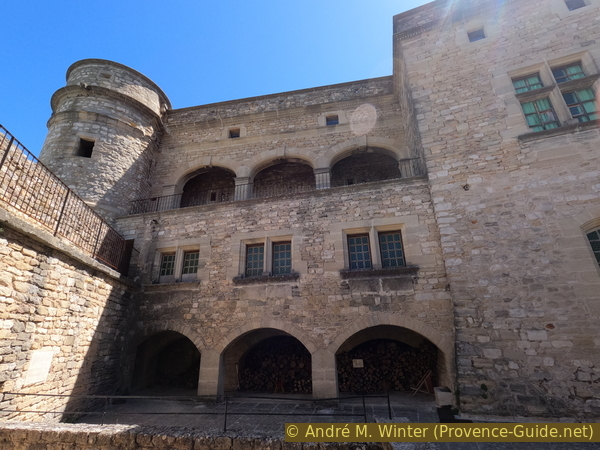
Loggia of the main courtyard of the Château du Barroux
The medieval defensive tradition is still present in the form of the square keep in the main courtyard.
No reproduction is permitted without the written consent of the author. (id8394)
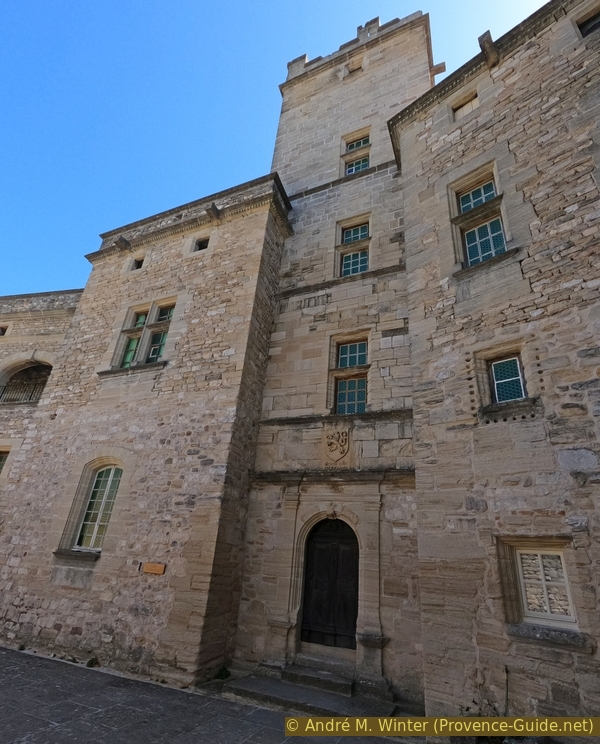
Square keep of the Château du Barroux
As mentioned above, the current owners also invest in whisky production. This ranges from raw material production to bottling. The château also maintains a fine cellar of French whiskies, which can also be purchased on-site.
Distillery tours are only available by reservation. These tours include a visit to the château.
No reproduction is permitted without the written consent of the author. (id8411)
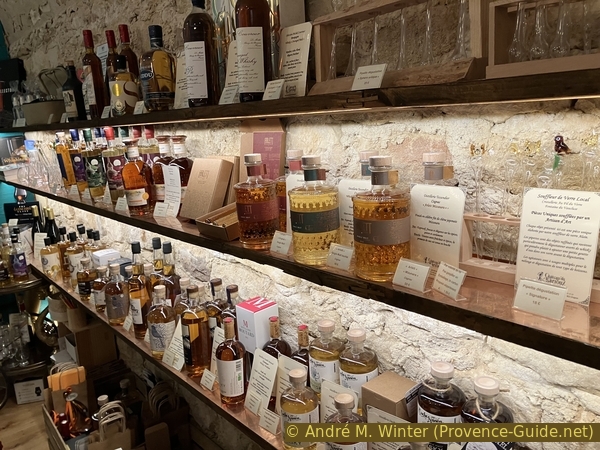
French whisky sales at the Château du Barroux reception
The Notre-Dame la Brune Chapel is accessed via the south postern gate.
Passing through this gate, one can reach the chapel as well as a terrace with a beautiful view of the village of Le Barroux.
No reproduction is permitted without the written consent of the author. (id8395)
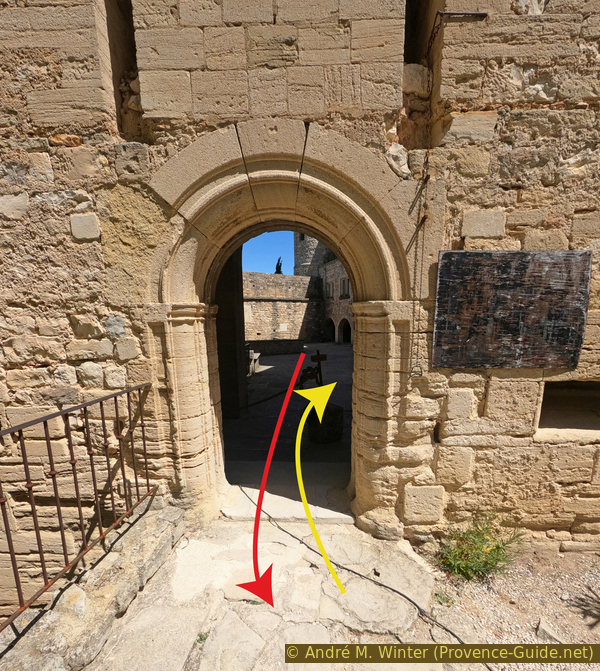
South postern gate of the Château du Barroux
The castle chapel was built at the end of the 16th century.
This small structure is of modest dimensions. The nave has three bays and a semi-circular apse.
No reproduction is permitted without the written consent of the author. (id8396)
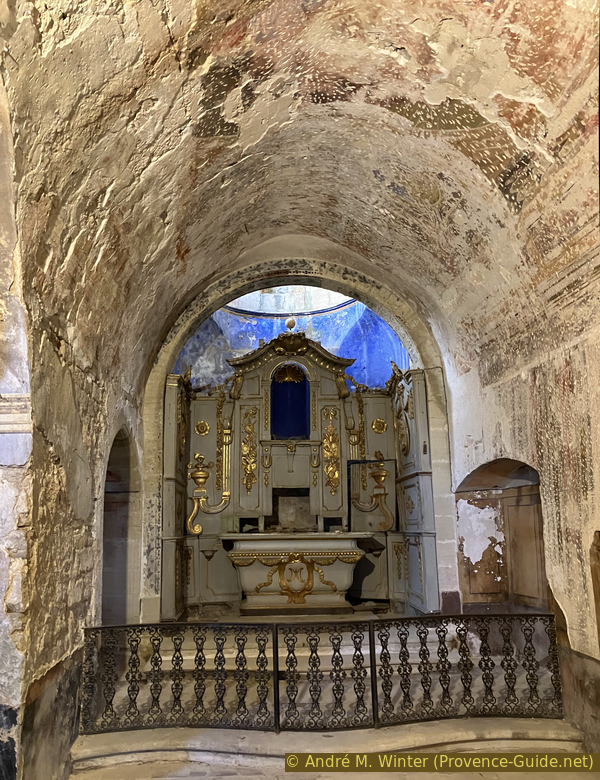
Nave of the Notre-Dame la Brune Chapel
The chapel was closed in the 1980s for safety reasons. Its condition deteriorated despite several restoration efforts.
The paintings were created between the 16th and 19th centuries. They cover the entire building.
No reproduction is permitted without the written consent of the author. (id8397)
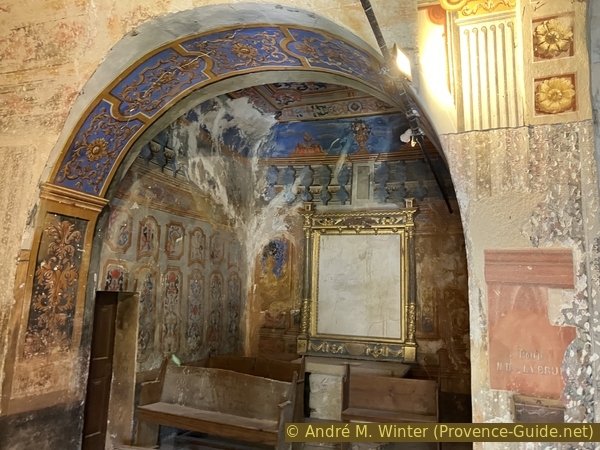
Side chapel of the Notre-Dame la Brune Chapel
The southeast terrace offers a panoramic view of the entire village of Le Barroux.
We will pass by it at the end of the tour.
No reproduction is permitted without the written consent of the author. (id8398)
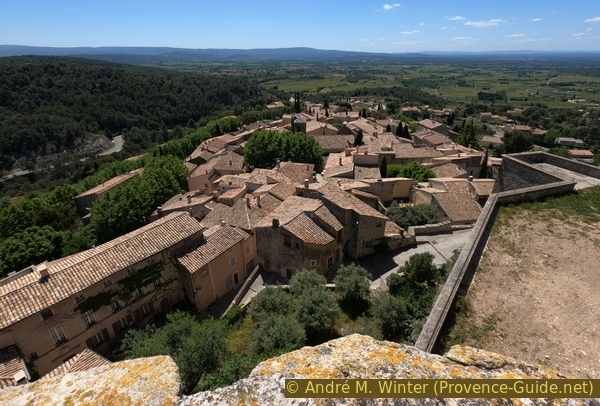
View from the southeast terrace of the Château du Barroux overlooking the village
The small terrace is located in front of a corner tower and the chapel's bell tower, which resembles a covered Provençal well.
We then return to the courtyard to continue our visit inside the building.
No reproduction is permitted without the written consent of the author. (id8399)
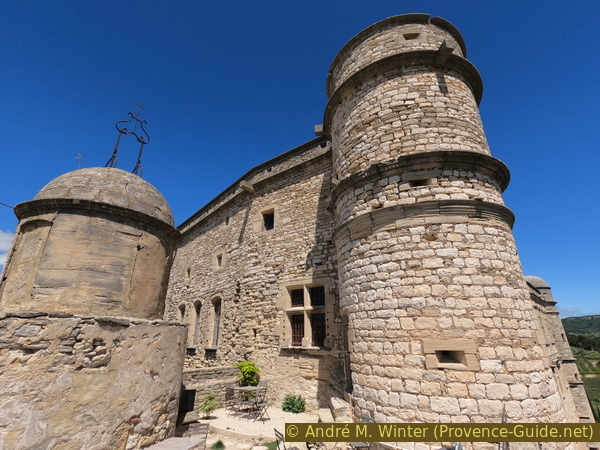
Southeast terrace of the Château du Barroux
The spiral staircase culminates at the top in a functional and beautifully crafted dome.
No reproduction is permitted without the written consent of the author. (id8400)
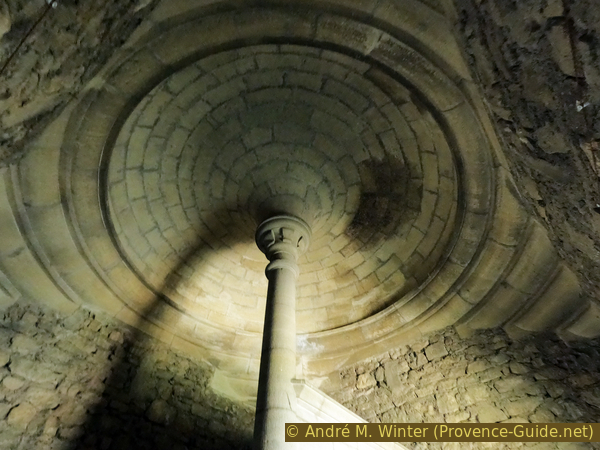
Dome covering the grand spiral staircase
One of the first rooms recounts the history of the building from the 12th century to the present day.
No reproduction is permitted without the written consent of the author. (id8402)
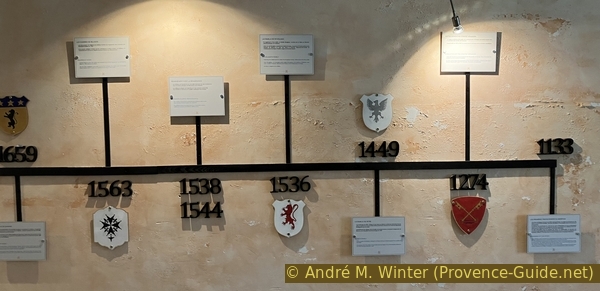
History of the Château du Barroux
The building was looted during the French Revolution and served as a stone quarry for over 150 years.
In the 1930s, the damage was documented. The photograph dates from this period. A new owner undertook restoration work, which was interrupted by the Second World War.
Nazi German troops occupied the castle. On August 21, 1944, in retaliation for attacks by members of the French Forces of the Interior (FFI) near the village on the road to Malaucène, the Germans set fire to the castle, which burned down for 10 days.
For another 15 years, the blackened ruins were walled up, and no one was able to take on the challenge of restoring them.
From 1959 to 1990, Rose-Léone Mouliérac Lamoureux, a military doctor, dedicated herself to the castle, which we can visit today.
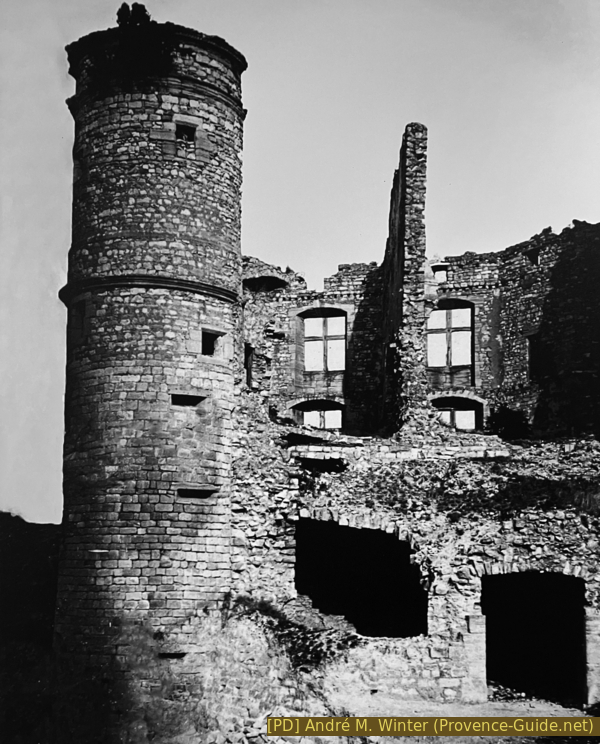
Photo of the Château du Barroux before the first renovations in the 1930s
You can walk through two large historic rooms.
However, there are also private apartments that are not open to the public. Given the castle's history, few original historical items remain.
No reproduction is permitted without the written consent of the author. (id8403)
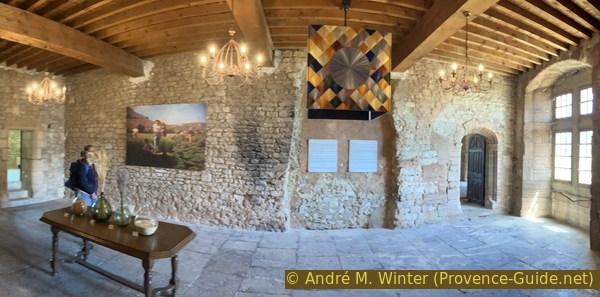
Audience chamber of the Château du Barroux
The windows are particularly large. This is undoubtedly due to the numerous alterations.
No reproduction is permitted without the written consent of the author. (id8404)
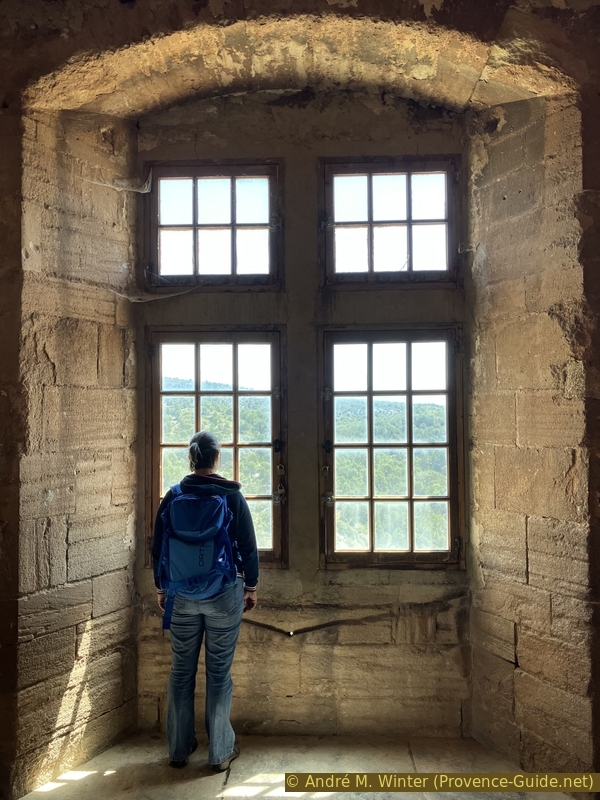
At the window of the audience chamber of the Château du Barroux
It's clear that the stones of this doorway were replaced out of debris.
No reproduction is permitted without the written consent of the author. (id8405)
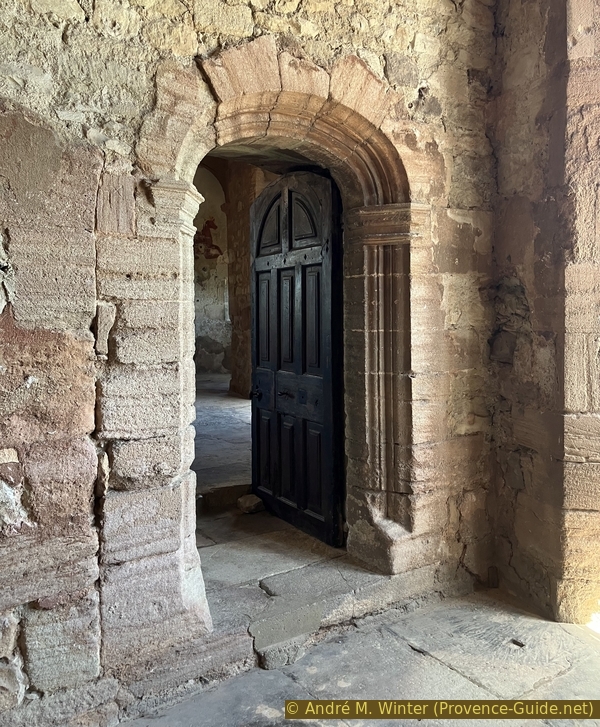
Passage to the Garenne room
The rooms are quite empty.
Photographs illustrate the production of the basic ingredients for whisky.
No reproduction is permitted without the written consent of the author. (id8406)
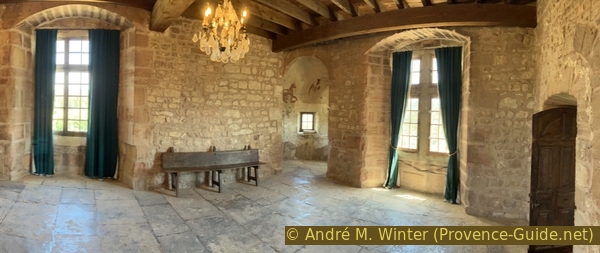
The Garenne room of the Château du Barroux
Graffiti from the 19th and 20th centuries are preserved in a corner tower.
Apparently, this turret was spared from looting, periods of neglect, and also the final fire.
No reproduction is permitted without the written consent of the author. (id8407)
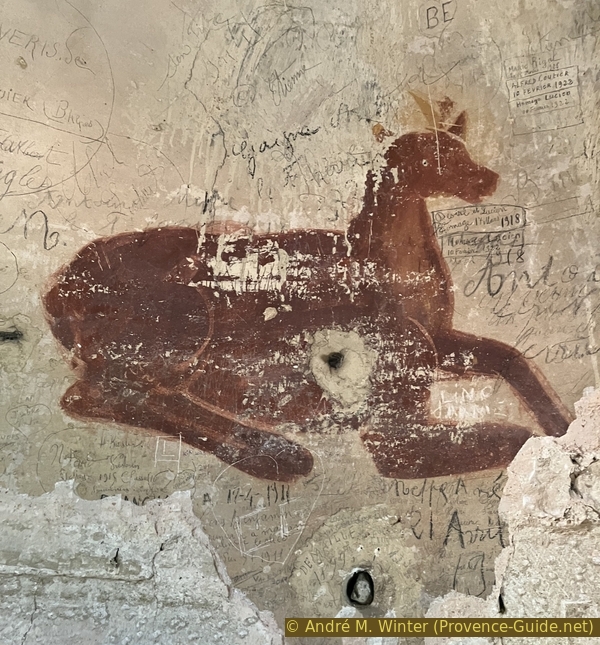
Graffiti in the corner tower of the Garenne room
This terrace, originally defensive, was integrated into the wall-walk.
No reproduction is permitted without the written consent of the author. (id8410)
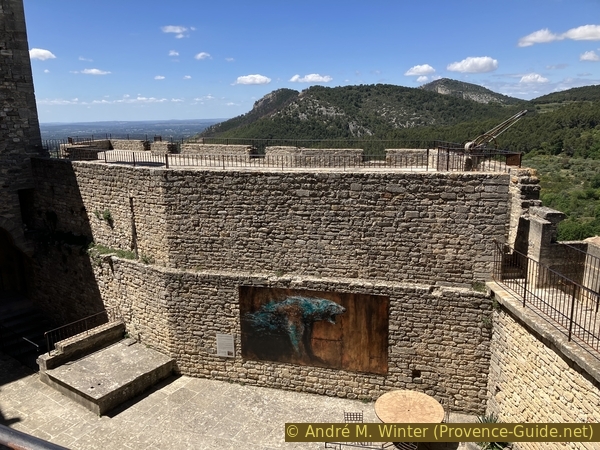
The west terrace of the Château du Barroux
We finished the tour of the castle and left through the same gate we came in through.
However, we take the path to the left shortly after leaving the grounds. This leads us to the upper car park.
No reproduction is permitted without the written consent of the author. (id8409)
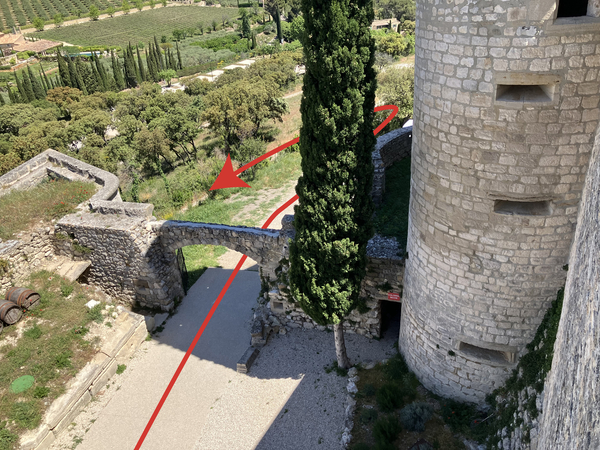
Northeast terrace of the Château du Barroux
When you see the Barry gate, you look for the concrete track that goes down to the right, it is not visible in this photo, but very clearly in the next one.
The Barry are the houses within the medieval castle walls.
No reproduction is permitted without the written consent of the author. (id8412)
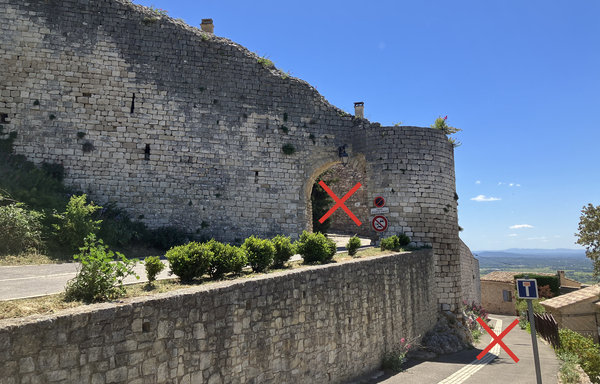
Access to the houses within the walls of the Château du Barroux
Section 2: Chapelle St. Christophe
➙ 0,8 km ... 20 min ➚ 35 m ➘ 60 m ↝ average
75% hard-surfaced city alleys, few marks
25% forest roads, few marks
The clues
- Chemin du Barry, 330 m
- Avenue de Verdun, 285 m
- St. Christophe Chapel, 315 m
We walk to the top of a hill to the southwest for a beautiful view back towards the castle.
We descend this steep concrete road to the northwest.
No reproduction is permitted without the written consent of the author. (id8415)
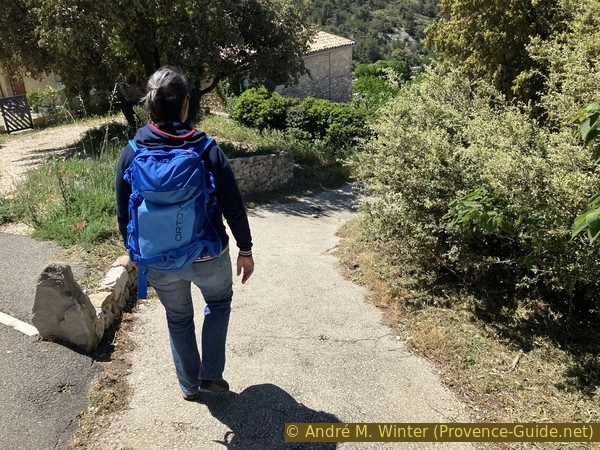
Descent of the Chemin du Barry
At the bottom, we turn left for a few meters, then bear right.
We're downhill again.
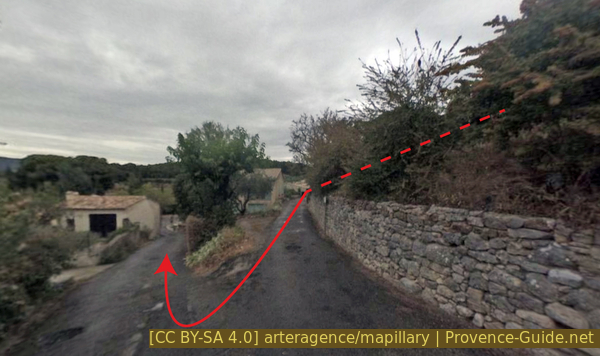
Rue du Pré and Rue de la Peratoure
Rue de la Peratoure leads us to a small roundabout where we bear sharply left onto Chemin Carre.
The slope is now less steep, and we walk a little longer without turning.
No reproduction is permitted without the written consent of the author. (id8416)
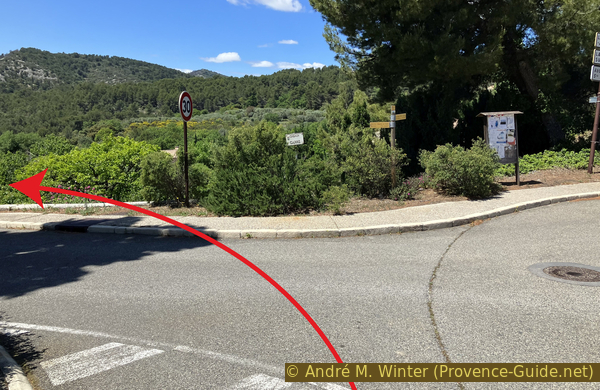
Roundabout and the Chemin Carre
Now for one last sharp turn in town: right onto Avenue de Verdun. It's still downhill.
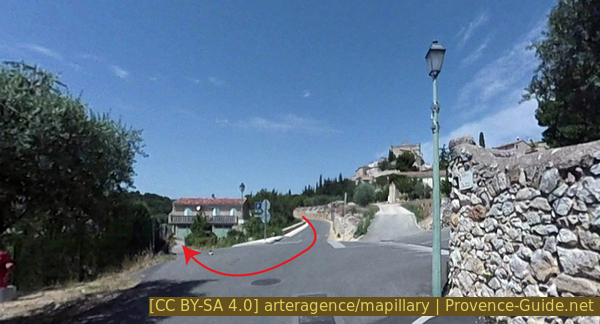
Chemin Carre and Avenue de Verdun
We arrive at the intersection shown in the photo. We continue straight ahead uphill on a forest track.
This is the direct climb to the St. Christophe Chapel. We'll also descend here later.
No reproduction is permitted without the written consent of the author. (id8419)
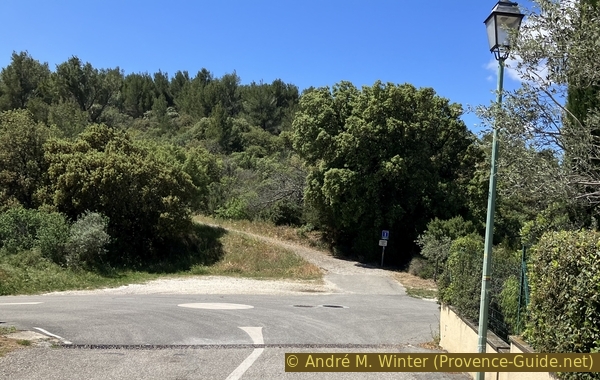
Avenue de Verdun and path to the St. Christophe Chapel
On the summit plateau of the small hill stands a large cross and a small chapel.
No reproduction is permitted without the written consent of the author. (id8421)
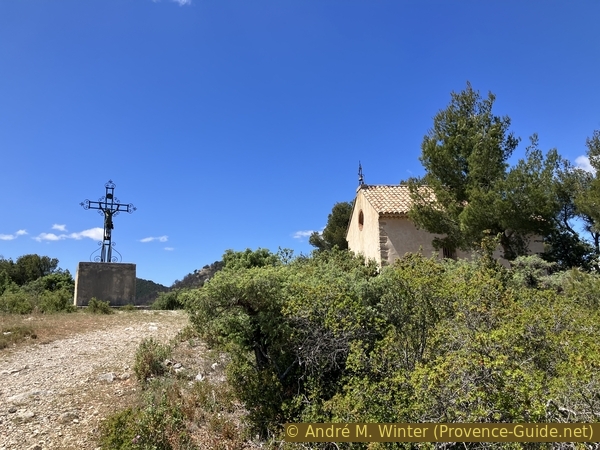
The cross and the St. Christophe Chapel
The nave is closed off by a gate, so you can clearly see into the very simple interior.
Unfortunately, there is no historical information about this chapel, lost in the woods. It may date back to the 17th century, however, the only available source gives 1860 as the year of construction.
No reproduction is permitted without the written consent of the author. (id8422)
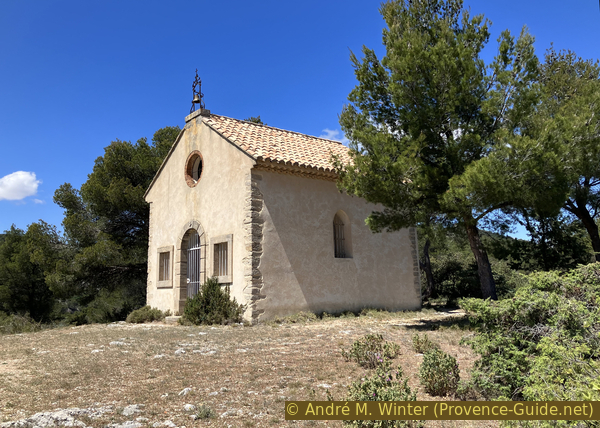
The St. Christophe Chapel
The chapel has, in any case, been recently renovated.
The interior is very simple with rather naive decoration.
No reproduction is permitted without the written consent of the author. (id8423)
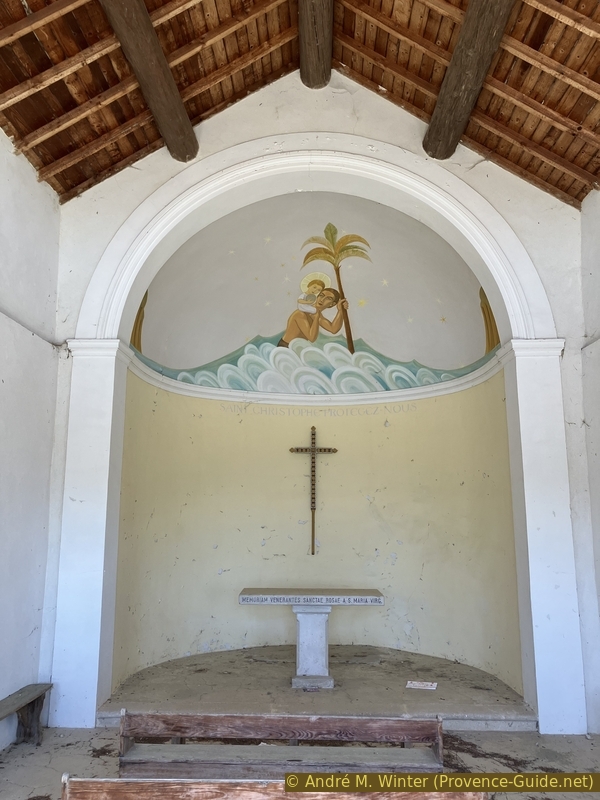
Apse and altar of the St. Christophe Chapel at Le Barroux
Looking west, you can see some hills between here and Beaumes-de-Venise. Lost and unmarked paths lead there.
No reproduction is permitted without the written consent of the author. (id8424)
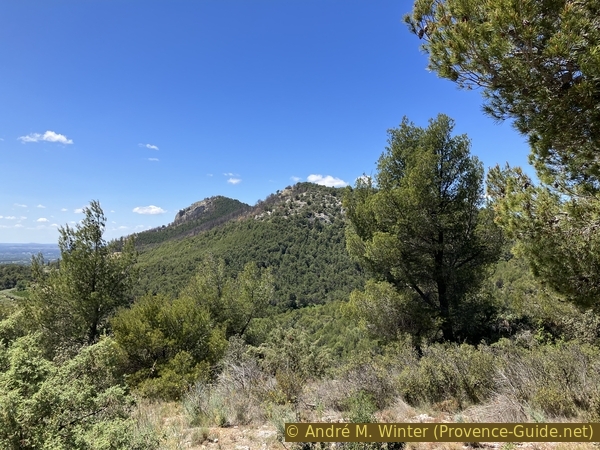
Le Graveyron and the Piè Logier seen from the St. Christophe Chapel
On the return way along the same path into the valley, you have a constant view of the Château du Barroux.
The photo at the top of the page was also taken from this road. You can see the south face of the château with the chapel in front of it.
Having reached the valley, we head up towards the next intersection where we continue straight ahead.
No reproduction is permitted without the written consent of the author. (id8425)
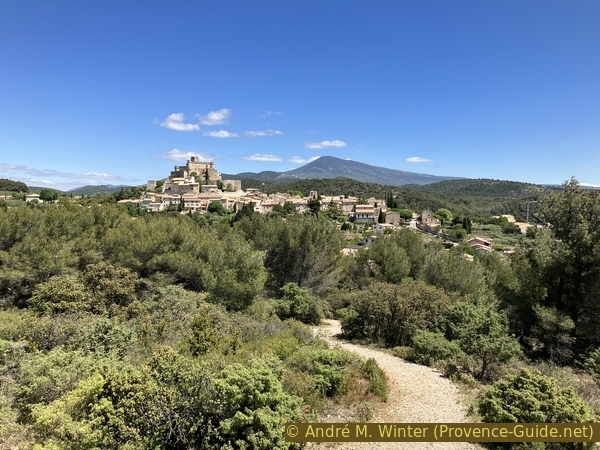
The Château du Barroux and Mont Ventoux
Section 3: Le Barroux Village
➙ 1 km ... 40 min ➚ 60 m ➘ 50 m ↝ easy
25% forest roads, few marks
70% hard-surfaced city alleys, few marks
10% easy trails, without marks
The clues
- St. Christophe Chapel, 315 m
- Avenue de Verdun, 285 m
- Place de la Croix, 315 m
- Place Philémon Piquet, 320 m
- Car Park Château du Barroux, 320 m
We return to the starting point by crossing through the village of Le Barroux.
We arrive via Avenue de Verdun at this intersection, where we continue straight ahead uphill on Rue René Char.
We continue along this road to the next obvious intersection. We turn left there, in front of a large green hedge, onto Rue des Écoles.
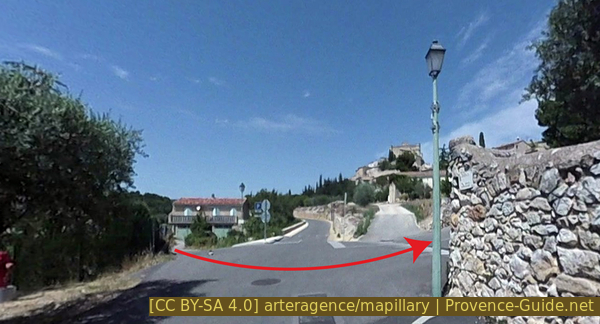
Avenue de Verdun and Rue René Char
Rue des Écoles leads us to this small square, which is mainly used as a parking lot. We take the uphill street towards the church.
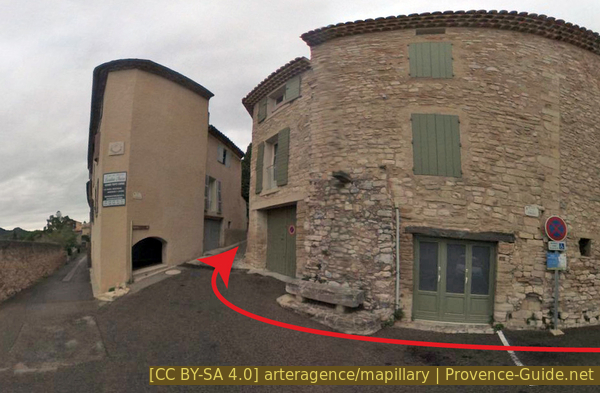
Rue des Écoles and Rue de l'Église
We can see the western facade of the church from the alley.
The Church of Saint John the Baptist in Le Barroux dates from the 14th century.
No reproduction is permitted without the written consent of the author. (id8428)
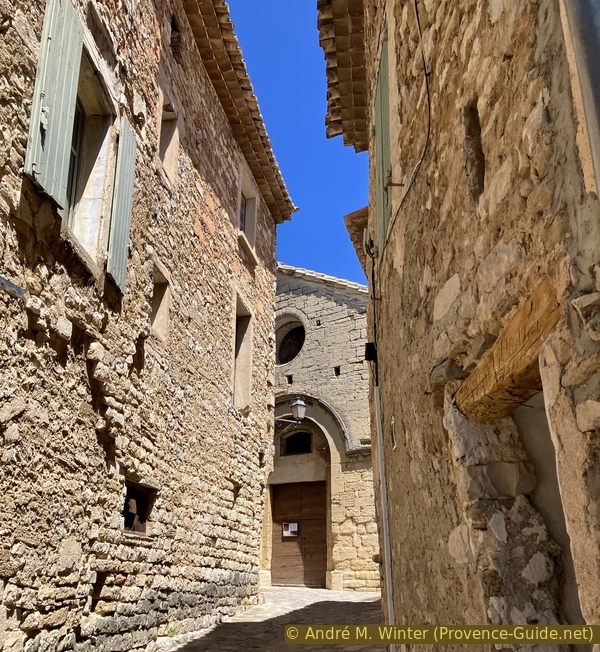
The Rue de l'Église du Barroux
The square-based bell tower has an external staircase leading to the 16th-century campanile.
No reproduction is permitted without the written consent of the author. (id8429)
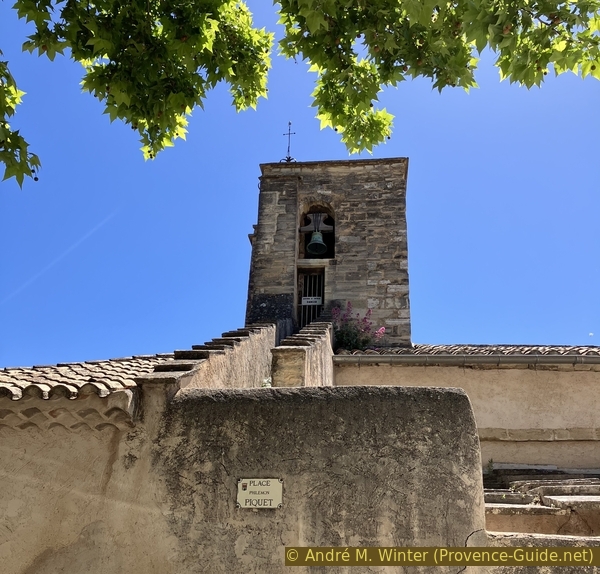
Le Barroux bell tower seen from Place Philemon Piquet
The obligatory fountain in Provence is also present. It has been beautifully renovated.
It is very simple because the town didn't have enough money for its construction 1842. Before that, there were only two fountains 600 meters away, and their water was of poor quality. The best source was then considered to be Saint-Andéol. Located more than 4 kilometers away, it required the construction of an aqueduct to bring the water. The municipality had to sell land for this purpose, and the process was lengthy. The work was not completed until 1847. A major breakdown, resulting in significant water loss, had to be repaired in 1903. From 1980 onwards, the fountain remained dry due to severely defective pipes. It was finally repaired and put back into operation in 1997.
No reproduction is permitted without the written consent of the author. (id8430)
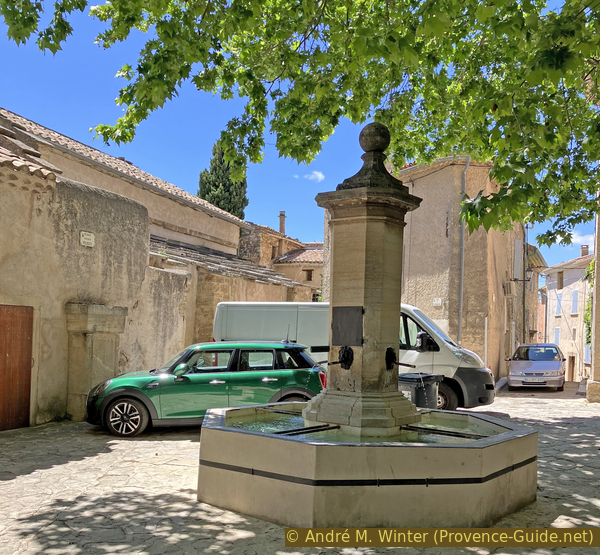
The Great Fountain of Le Barroux
The Hôtel-Dieu is a former hospital. The building is now privately owned and available for rent.
This hospital was established in 1770 following a bequest of the house and a sum of money for the relief of the poor.
No reproduction is permitted without the written consent of the author. (id8431)
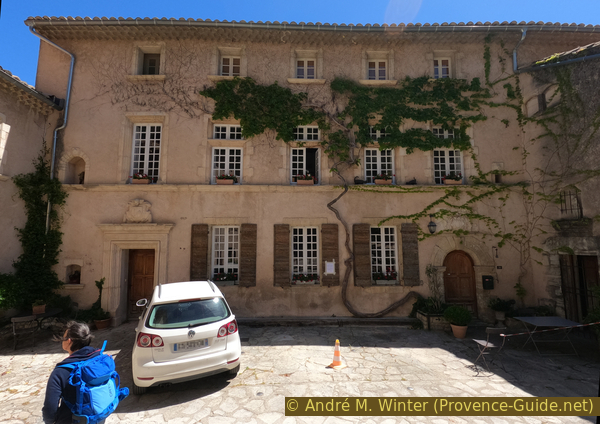
Le Barroux Hospital
In a cul-de-sac to the right of the hospital stands a remarkable old mill. The iron gate allows a glimpse inside.
The last lord of Le Barroux refused to open his mill to the townspeople. In 1790, during the French Revolution, the town decided to convert the village's former butcher shop into a communal mill. This explains why the presses are located inside, unlike other examples such as those in Carcès or Cotignac in the Var region. It remained in operation until 1853.
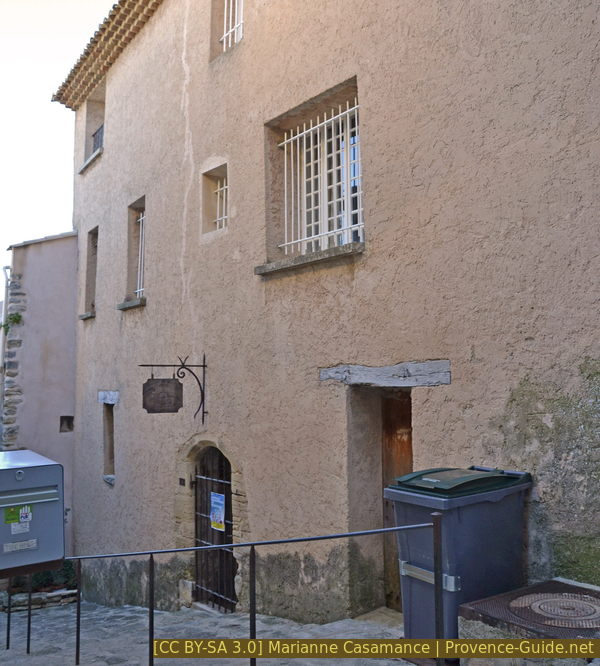
The alley of the communal mill
The mill is housed in two rooms. The first contains a mill with a vertical millstone rotating on a horizontal one. The second contains several hand presses on the wall.
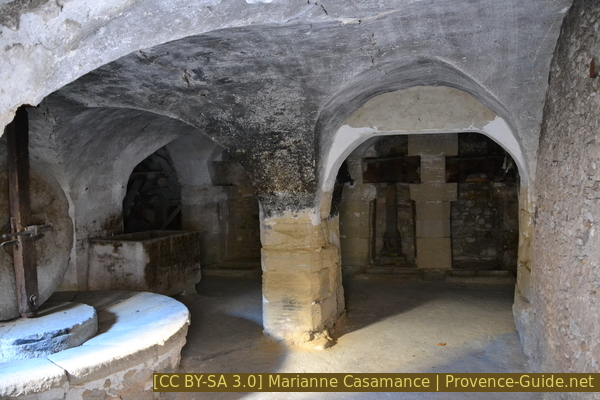
The communal oil mill of Le Barroux
Now, we continue down this same road.
We pass some beautiful village houses, so typical of the region.
No reproduction is permitted without the written consent of the author. (id8434)
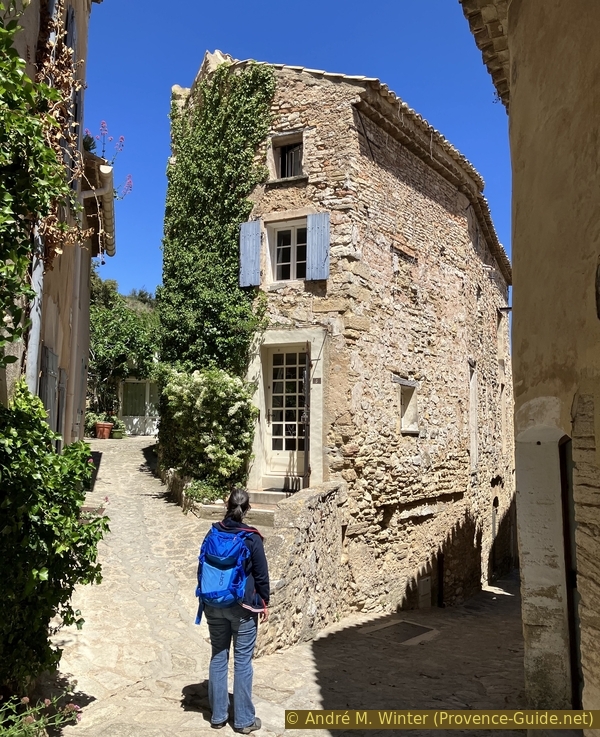
Alleys and houses in the centre of Le Barroux
A hint of past wealth can be seen in some of the doorways.
No reproduction is permitted without the written consent of the author. (id8435)
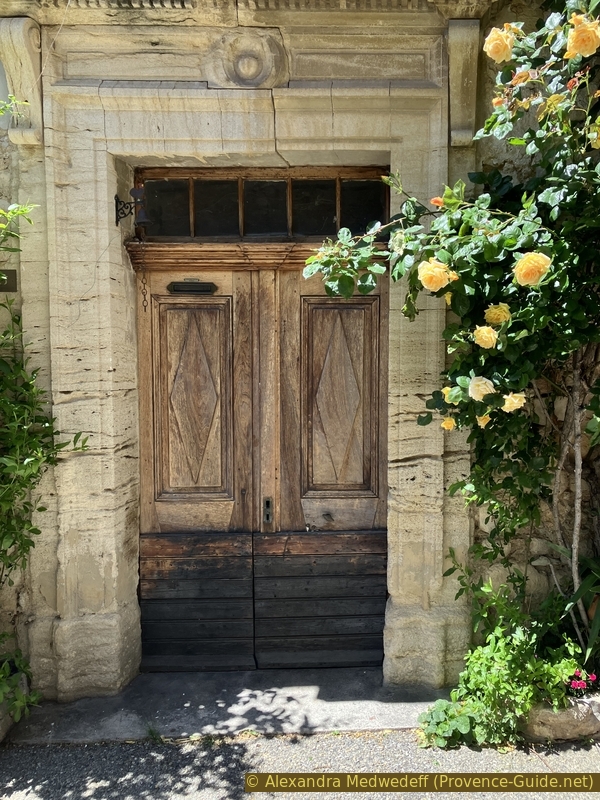
A well-maintained gate in Le Barroux
The wash house is also very classically Provençal.
There are some differences, however: it's in the center of the village, which is unusual. It has a basin that you can almost walk around. And there are clean water basins behind the main one.
No reproduction is permitted without the written consent of the author. (id8436)
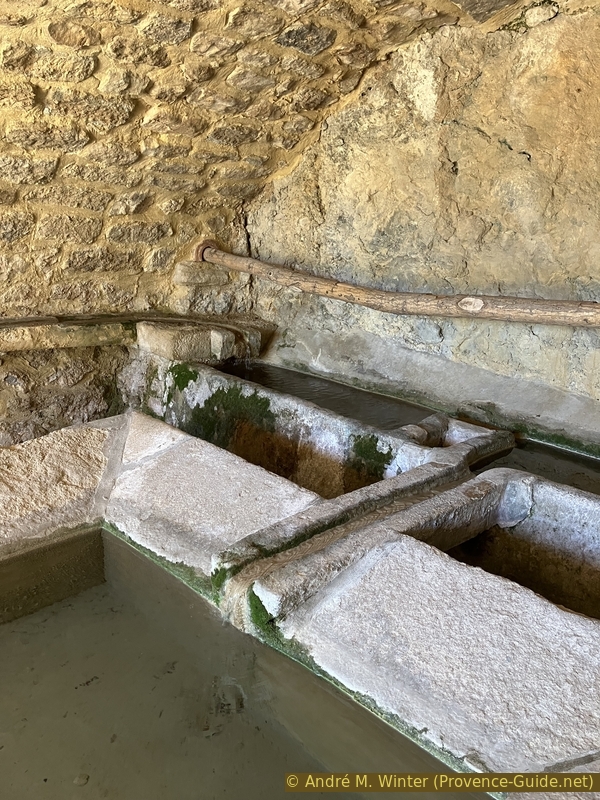
Basins of Le Barroux wash house
When we reach the northern edge of the village, we see a path that goes uphill to the left towards the parking lot.
Those returning to the bus continue straight ahead and then keep to the right.
No reproduction is permitted without the written consent of the author. (id8437)
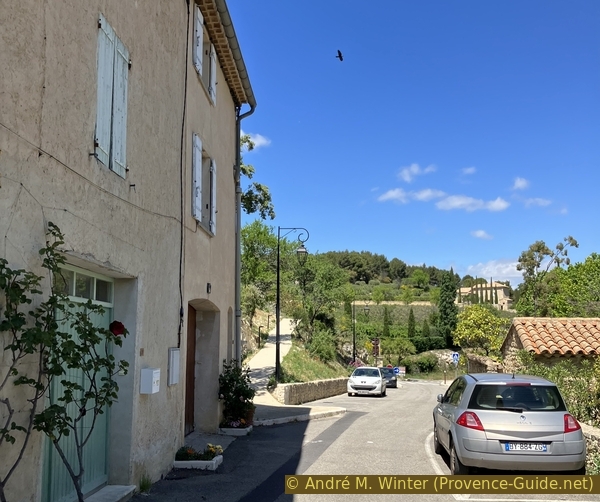
North exit of the village and access to the parking lot
Sources and additional information
It is better to use a good topographic hiking map: this tour is on the IGN map "Carpentras", scale 1:25000, 3040ET.
If you don't want to bother with a paper map, you can also use mapping apps on your cell phone. On the one hand, it is the Cartes IGN app from the official map service. However, it requires access to the data network and this is sometimes difficult in canyons or remote locations.
Alternatively, you can use apps that store data directly on the device. They're generally not free, but they don't cost much. We mainly use OSMAnd, here it is possible to add contour lines, relief shading, markings and others. To store this data on your phone you need a lot of space.
Of course, one needs access to satellites for the GPS signal with any app. In some canyons this is not the case. Therefore, do not rely on the position shown, but read the map on your phone as you would read it on paper. Most apps are available for Android and iPhone. The applications usually allow us to record the route travelled and also view the GPS files offered for each of our hikes.
This page has been seen 968 times since 20 March 2024.