Pont de Caronte
Industrial and historical site
15 min
ruin
Site history
This bridge is an industrial gem from the early 20th century. It was completed in 1915. Although it was dynamited by the Nazi German occupiers on 18 August 1944, it was quickly put back into provisional operation in 1945. It was then rebuilt in 1954 by the same company that had originally constructed it: Schneider & Co. of Chalon-sur-Saône. The swing span resembles the one before its destruction.
No reproduction is permitted without the written consent of the author. (id8546)
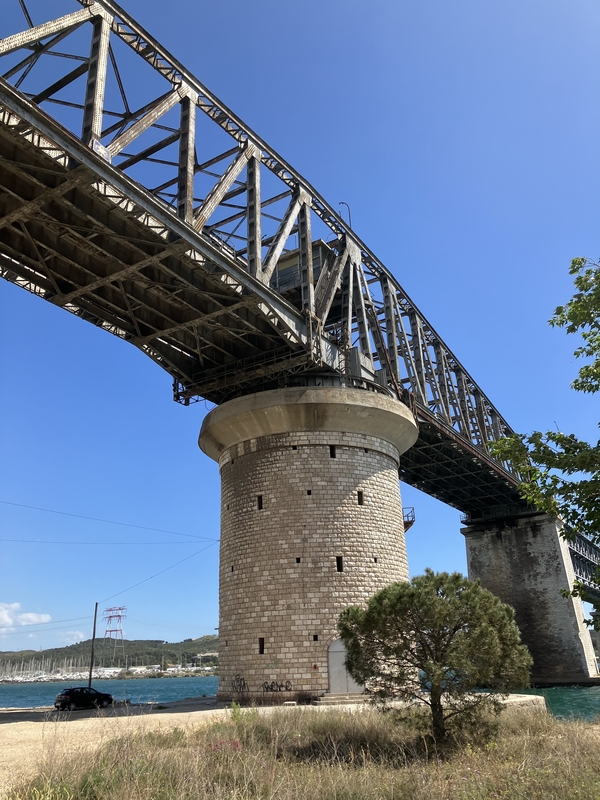
The middle pier of the Caronte Bridg
Description
The Caronte Bridge is a railway bridge nearly one kilometer long that carries the Miramas to L'Estaque line, via the Côte Bleue, over the Caronte Canal, which connects the Étang de Berre to the Mediterranean Sea. It is a double-track bridge.
It is a 12-span steel truss bridge built on masonry piers.
No reproduction is permitted without the written consent of the author. (id8543)
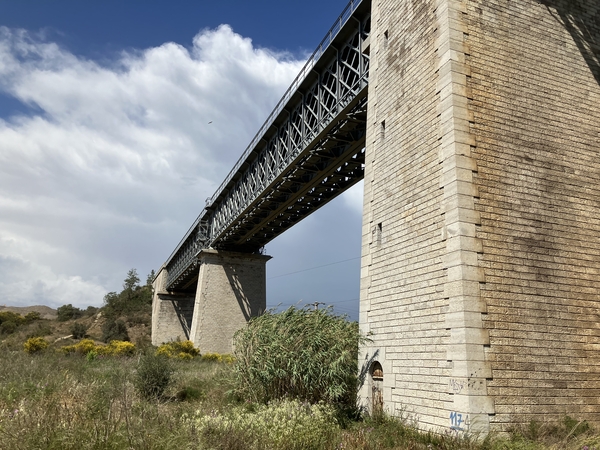
The piers north of the Caronte Bridge
The swing gate allows passage for ships that are too tall. The clearance is 23 meters when closed. Ships must register at the Port of Martigues, and the gate opens between train passages. The opening and closing maneuver takes just over five minutes.
Gasoline engines drive a shaft that connects to gears, which in turn engage a circular rack. These gears, meshing with the circular rack, are driven by the same shaft and connected by differentials. Rail engagement and release are achieved using compressed air.
The control room is located in a cabin above the tracks, it is visible in the photos above the circular pier.
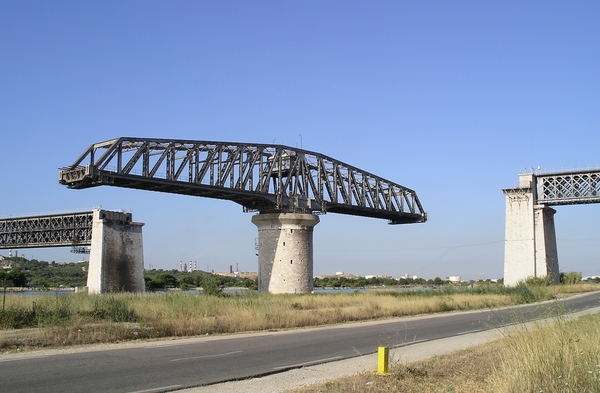
Caronte railway bridge turned
Access by public transport
You can't get directly to the Pont de Caronte by public transport. The most unusual way to access it is by TER train between Marseille and Miramas. Leaving from Marseille, you go directly over the bridge and get off at the stop just after, called Croix Sainte. It's a very small train station. See Zou! (only french) for the timetable.
The map on this page shows the pedestrian access route in purple.
Exit on the south side and then turn left onto a dirt path that runs alongside the railway. You'll come to the small road Chemin du Petit Pont. Turn right onto this road and continue south for 300 meters.
You'll then arrive at the Boulevard Maritime, which isn't very attractive. Turn left towards Martigues. At a left-hand bend, when you have the large bridge clearly in sight, take a small path on the left to reach the bridge. You'll then be near the round pier with the swing deck.
Access by car
The fastest access by car is via the A55 motorway.
The access route after the motorway is marked on the map on this page in burgundy red.
Go through Martigues and exit at Croix Sainte, keeping this destination at the next exit. At the following roundabout, follow signs for Port-Bouc. The next roundabout has no signs: turn left and then immediately right. Follow the left turn and continue straight ahead on Rue des Pétunias. Then bear slightly left and then right onto Allée des Bleuets.
You will come to a roundabout. Turn right here. You can already see the bridge. At the last roundabout, take the left exit into the very neglected parking area by the canal.
No reproduction is permitted without the written consent of the author. (id8545)
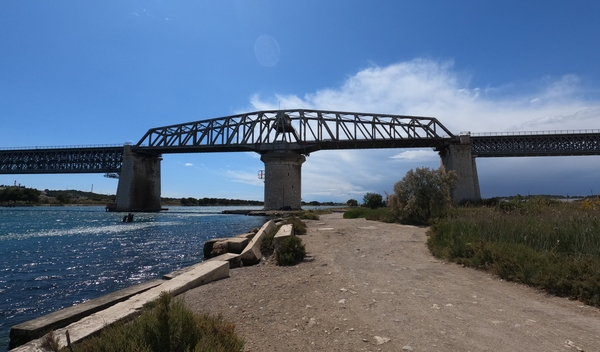
The Caronte Bridge seen from the east
View as coming from the car park.
The central pier with the rotating platform was completely destroyed during the retreat of the German occupiers.
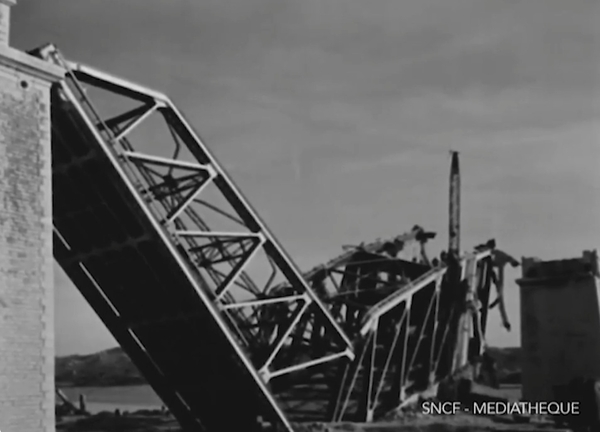
The central pier of the Caronte Bridge, dynamited on 18 August 1944
Just after the German withdrawal and still long before the occupiers' surrender, plans were made to rebuild the Caronte Bridge. Initially, a temporary solution was envisioned, with a lifting deck. The southern pier was doubled to allow for later reconstruction to its original design.
The dismantling of the destroyed sections alone took several months due to a shortage of materials.
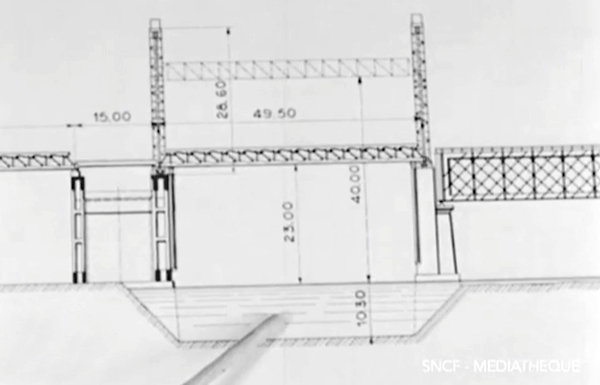
Plan of the provisional reconstruction from October 1944
Here we see the bridge with the temporary solution. The lifting deck is a Krupp bridge taken from war booty.
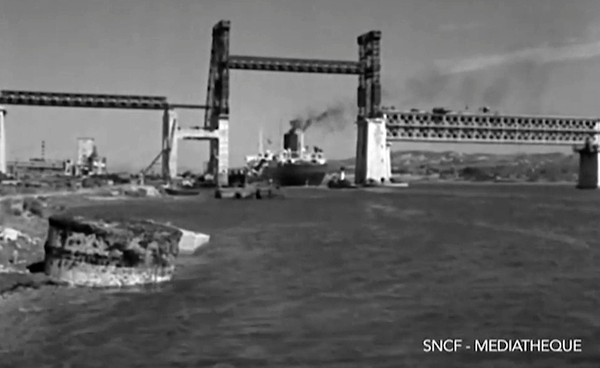
Reopening of the provisional Caronte Bridge on 19 July 1945
The plaque affixed to a pier on the north bank primarily praises the politicians of the time. It begins with: "Alexandre Millerand, President of the French Republic, visited on 8 May 1922, the initial works for opening the Étang de Berre to maritime navigation and the development of Port de Bouc and Caronte, initiated by the Marseille Chamber of Commerce."
No reproduction is permitted without the written consent of the author. (id8542)
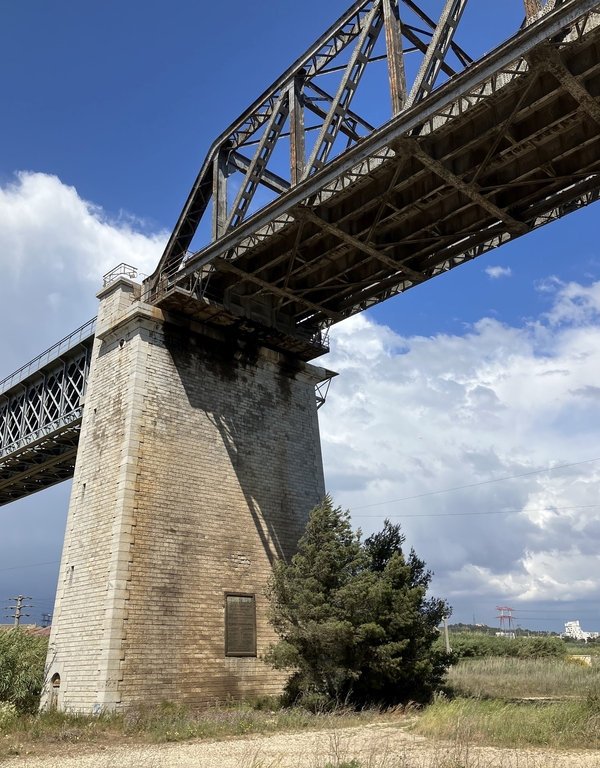
North pier with commemorative plaque of the Caronte Bridge
Below is a fasces, used as a political symbol. It evokes justice, the assertion of legitimate authority, collective strength, the Republic, and sometimes revolution. It would later also become a symbol and the name of Italian fascism. On either side of the bundle are these names: "M. Y. Trocquier, Minister of Public Works, M. L. Pasquet, Senator and President of the General Council, M. L. Thibon, Prefect of Bouches-du-Rhône, Le Dr. S. Flaissières, Senator and Mayor of Marseille, M. Hubert Giraud, Member of Parliament and President of the Chamber of Commerce, M. G. Bezault, Chief Engineer."
Then are named the "contractors: Caronte Maritime Establishment (Sté. Ame), Major Hydraulic Works Company (Sté. Ame)."
No reproduction is permitted without the written consent of the author. (id8541)
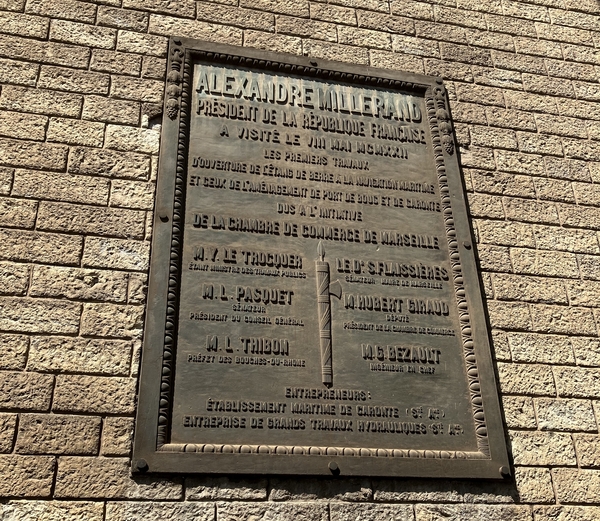
The commemorative plaque of the Caronte Bridge
This is the original plaque affixed in 1922.
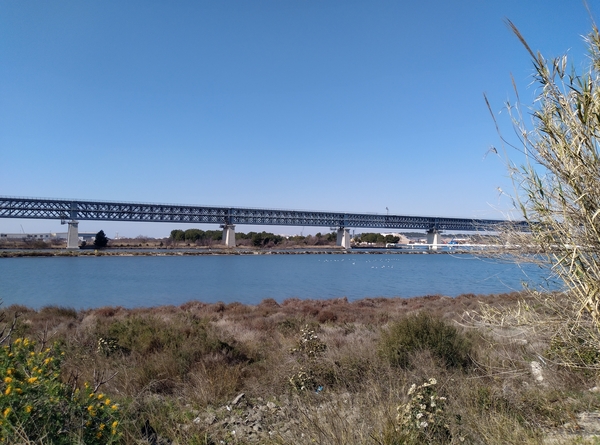
Caronte Viaduct seen from the channel bank
No reproduction is permitted without the written consent of the author. (id8544)
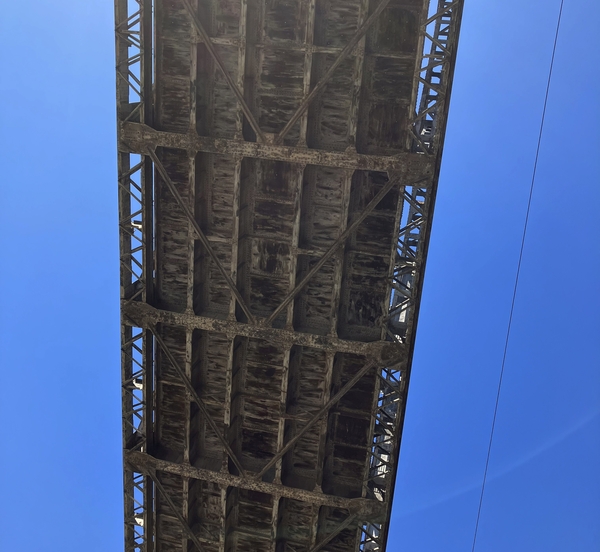
The steel truss bridge of the Caronte Viaduct seen from below
No reproduction is permitted without the written consent of the author. (id8540)
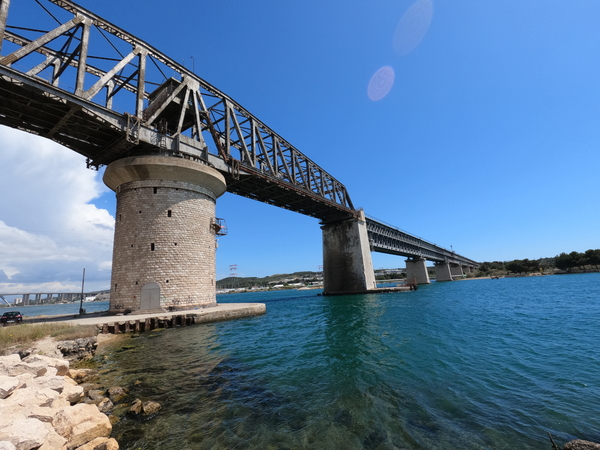
The Caronte Bridge